Nov 7, 2010

It's time to step it up.

The quintessential question: What do you want to be when you grow up? An interesting and insightful question.  But knowing what you want and what you will get are far from the same. Don’t get me wrong, this is a great thing to ask to a six year old. But what about when it’s not a six year old, but rather a sixteen year old.  When you’re younger you have the ability to dream without limit and aspire without constraints.  However, as you get older these limits and constraints do come into play. No longer are you simply dreaming for the far future but instead, are facing the oh shit! reality of choosing a life path.
The problem that most teenagers have is that we are stuck in the mentality of a six year old. We have yet to realize the true impact of our choices.  By the time we do realize that maybe we should have tried a little harder, we are working low wage jobs living surviving from paycheck to paycheck. Reading the book Nickel and Dimed reinforced these thoughts in my mind. Barbara, the author, stresses the importance of education in our society today. She explains how difficult it is for those with little education to find a job paying any more than minimum wage.
 I’m sure that the people whose lives Barbara shared in her novel did not wish for themselves to live such lives of struggle. I guarantee that they spent their youth filled with hopes for their future. However, I would also bet that they did not actively work at achieving those dreams.  It’s not enough to want something, you need to be your own self advocate because, if not you, then who?
If there is anything that I have taken away from these past few weeks, it’s that I truly am grateful for my education. I take blame for any mistakes I may have made in the past. I am now working my hardest to try and reverse these things. I don’t want to want a good future , I want to achieve it.


Reflection

I love that feeling that you get when something finally “hits you”, when you feel that strange sense of realization. I would have to say that this is how I’ve felt about my English class these past few weeks. Nickel and Dimed is probably one of the most boring pieces of literature that I have suffered through, however, I’ve come to realize how much I truly have taken away from it. While it may have taken several long hours to read, it also gave me time to reflect on what was being said. My eyes have been reopened to the idea of diversity, be it good or bad. I now realize how little 7.25/hour really is.
This American Dream that thrives in each and every one of us is undoubtedly alive. But what is it? What is it that keeps us thinking that there is this idea for social mobility and that it is possible to break free from a life of struggles? It’s hope. Hope that the future might change for each of us simply because chance has favored a select few in the past.
These discussions lately have left me with a myriad of questions. This is not something I am complaining about though; I think that these concepts are things that, when reflected on, reveal a true insight to self and society. The most troublesome question in my mind right now is what’s the next step?
Do we live on hope and dreams or do we face the reality and the truth in numbers. Hope is this idea that no one can take away from you, but at the same time it can blindside you from the facts. There are countless numbers of people on welfare, working multiple jobs (if they can find one) and still have to spend cold night in their cars. The reality is that our economy is at a stand-still. We need to stop waiting around, living with this idea of the American Dream and get things together.
Honestly, I feel the best way to go about making it by, would be to not look at the bigger picture. Do not strive to be on top. Be the best that you can be, not the best you that someone else wants you to be.

Oct 24, 2010

Is it enough?

When thinking about whom in our society is wasteful and often takes for granted the things in life that they do have, it is easy to point an immediate finger to the wealthy. Well if you were to take that finger and turn it around 180 degrees then you would have the right culprit. That’s right, it’s you! Don’t even try and say that I have no way of knowing if you take things for granted or not, because I do know. Maybe you haven’t taken the time to reflect on how easy you really do have it. Hopefully I can offer some insight to you.
While reading the book Nickle and Dimed I’ve come to see the true value of money. I myself have a job at the age of only sixteen. I make just above minimum wage and to me my paychecks seem rather substantial. But I don’t know how people live off of this same salary that I take for granted. I waited three months for that job call-back, at the time I didn’t care much. However, had I been one of the 72,598,398 under eighteen and in poverty, those three months would have left me cold and hungry.
The idea of supporting yourself or even a family on such menial wages is absurd. $7.25+ is acceptable pay when 90% of that money is going to a savings account because your parents are still paying for your cost of living. But what about the woman with a 9month old baby, no healthcare, living in a van outside Wallmart. Is $7.25+ an hour enough for her? If there is even the slightest hesitation in answering that question then you still do not understand the truth of these circumstances. But I think it is hard for anyone to truly grasp these conditions unless they have been there themself.
This is why I am left questioning the choices being made, or being claimed to be made, in this recent election between Barrett and Walker. The media is filled with ads lashing back at one another and never truly addressing the problems at hand. I have no doubt that they have spent extensive time on research to back up their reasoning’s but what does research have in comparison to experience? I would like to see how their views about welfare reform would change after spending a week in the shoes of the woman mentioned earlier. It is near impossible to truly grasp the life on minimum wage unless you have been there. So again, what reason should we believe Barrett over Walker or vice versa? Are they really who we should be consulting about such issues?
Maybe I am wrong; maybe these men do have the credentials to make these choices. Perhaps I haven’t stumbled upon them yet. I leave you with that, as I continue my search for such answers….

Oct 17, 2010

Thirteen Virtues and Today

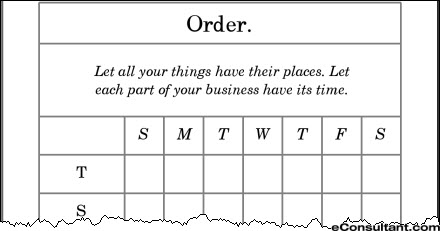
Temperance, silence, order ,resolution ,frugality ,industry ,sincerity ,justice ,moderation ,cleanliness ,tranquility ,chastity ,humility.  Don’t those sound like great things? One of the greatest men that America has ever seen thought so.  Around 1730, Benjamin Franklin constructed this list and called them the Thirteen Virtues. He logged each one of these virtues in a small book which he kept with him for most of his life. At each day’s end he would evaluate himself on how well he achieved each of these virtues.  In his Poor Richard’s Almanack Benjamin says “Be temperate in wine, in eating, girls, and cloth, or the Gout will seize you and plague you both." However, it is important to note that Ben Franklin gorged on food, often womanized and dressed to impress.
I see this as the perfect example of what is going on in our society today.  We all have these great ideas in our heads about how we should act or how we want to be. But sadly, it’s not that easy. We all falter. While Ben Franklin did make mistakes when it came to following his own rules, this does not mean we should discredit the foundation that he had created for himself. The basic ideas that he created are still of great value. I think that they show us, as Americans, that as long as we keep our goals insight it is okay for us to make mistakes. As long as we keep moving forward with our basic morals in mind, the faults we make will seem rather insignificant.

"saying 'I'm sorry' doesn't always mean 'I take back what I did'"
"If we focus on the people we still have, rather than those we've lost, the world seems a lot less lonely"

MLA CITATION-
Kurtus, Ron. "Benjamin Franklin's Thirteen Virtues." School For Champions. N.p., 7 February 2005. Web. 17 Oct 2010. <http://www.school-for-champions.com/character/franklin_virtues.htm

Oct 10, 2010

Make It or Break It.

A community is always temporary; they all see an end eventually. The part that should be noted about each is the time-span that they remain stable. The stronger the base of a community, the more likely it is to strive. If you try to hold a house on a single up-right toothpick it will crumble beneath the weight. Much is the same when looking at a community. It would be beyond simple to compile a myriad of things that could either make or break a community but when presented with this question there are a few examples that immediately come to mind.
Solidify: When a large sum of people is place together there are many things that will ensure their success. The most basic attribute that is needed is common interest. As simple as it may seem it still remains a vital ingredient in a community. When interpersonal relationships are strong it is more likely for people to see others as a means for support. Working together will much more smoothly than if there were constant conflict. Everyone would be able to live a rather simple life.
Destroy: One way to ensure a community destroys itself is to present it with a controversial topic that will strike fire among the people. When people become divided it creates intense tension in the air. The kind of tension that will eventually break out into fights or worse. Rumors and secrets are another catalyst for destruction. When lies are spread at a massive rate this can bring chaos to the community or even multiple.